Showing posts with label DigitaLoz. Show all posts

Wednesday, October 1, 2014

Grand Budapest Hotel Review

By.DigitaLoz

Plenty of films are released each year, yet most of them are throwaways made for the audience to sit back, watch for 90 minutes and have a good time. But a percentage of these movies are made by directors worth following. One of said outstanding directors is Wes Anderson. Anderson’s films are all full of stunning visuals, quirky characters and captivating camera work. Incidentally, I was looking forward to his next project: The Grand Budapest Hotel.

The Grand Budapest Hotel tells the story of the famous concierge M. Gustave (played by Ralph Fiennes) and his adventures with his new lobby boy, Zero Moustafa (played by Tony Revolori and F. Murray Abraham). With a cast of academy award nominees and winners, this Anderson flick pulls its weight in its troupe alone. And even the new comers, like Revolori, do a fantastic job. Yet among the A-list stars and big names there are two that shine brighter than the rest: Ralph Fiennes and Wes Anderson.

M. Gustave is a compelling character; he is a womanizer with an exclusive type of woman—rich, blonde, and old. Beyond his tastes in women, there is a sense of pride in Gustave’s work as a concierge for the Grand Budapest. His loyalty to his job is unquestionable. Fiennes manages to make an otherwise unlikable character into something enjoyable. He portrays Gustave with so much gusto that he seems to be having a blast.

 
Nevertheless, it is Wes Anderson’s directing style that really hits the nail in the head. All of Anderson’s trademark tricks, from the outdated look yet colorful environment to the use of symmetry in every shot, are all present in The Grand Budapest Hotel. The film is beautiful. It possesses the old timey feel that make all of Anderson’s films stand out.

However, The Grand Budapest Hotel is not all about pretty colors and engaging settings. In a way, it is a coming of age story for the character of Zero, which unfolds before a murder and the last will and testament of the victim. I was thoroughly entertained by everything this film had to offer, yet I’m not sure it is quite as good as Moonrise Kingdom. And even taking that into consideration, it still ranks in the top of Anderson’s work.

Wednesday, September 24, 2014

Jodorowsky’s Dune Review


By.DigitaLoz


“One does not go to the theater to escape from himself, but to reestablish contact with the mystery that we all are.” – Alejandro Jodorowsky
 Some films change the way we look and experience cinema. These flicks transcend the usual conventions of their times and become beacons of inspiration for future filmmakers. Films like Kubrick’s 2001: A Space Odyssey, Bergman’s Persona and Truffaut’s 400 Blows are still among the curriculum in film schools long after their glory days have passed.
Alejandro Jodorowsky is one of these filmmakers. As well as the others, Jodorowsky is a moviemaker who is passionate about his craft. Money and fame are not his goals, only the art of filmmaking is. Jodorowsky is the Chilean director and comic book writer responsible for some of the weirdest and astounding films (El Topo, The Holy Mountain) in the history of cinema. After his initial success, he was asked what his next project would be. It was then that he chose to adapt the critically acclaimed science fiction novel Dune. 
 Hence, Alejandro Jodorowsky embarked on a journey to find his “spiritual warriors” (as he called them) and make a film that would change the world and humanity’s the consciousness forever. Jodorowsky’s Dune tells the story of Alejandro’s quest to make an influential film and the talent he found through the project. Jodorowsky’s teams’ talents didn’t come from their abilities, but from their love of the art. With a cast of unusual actors like Salvador Dalí, Orson Wells and David Carradine, artists like Jean Giraud (MÅ“bius), Chris Foss, and H.R. Giger making concept art, story boards and designing the aliens and the spaceships, and music by Pink Floyd, it was the dream team to end them all.
 At the helm, there was none other than Jodorowsky leading the team like a general. People seemed to be attracted to him. During the documentary, I could not help but be fascinated by the way Jodorowsky talked about filmmaking and life in general. But as expected, the film was ahead of its time and thus was never embraced by Hollywood. Yet another project rose from the ashes of Jodorowsky’s Dune: Alien.
 After watching this documentary, you will wish you could go back in time in order to have this movie made. It was intended to change the world; however, it’s intriguing to know that a film that never got made still changed sci fi cinema forever.

Thursday, September 18, 2014

The Raid 2 Review

By.DigitaLoz


   In the year 2011 martial art fans got a glimpse of Iko Uwais amazing skills. The Raid: Redemption was an instant hit for its ferocious action, intense feelings of claustrophobia and hyper violence. Director Gareth Evans went down as having made one of the best action films of all time. So after all the hoopla, it was obvious that the film would get a sequel. How could it not? People were enthralled by Uwais dominion of pencak silat, which he had been practicing since he was very young, that it was apparent he should get more airtime.


   The Raid 2 forgets all about the enclosed spaces, and instead goes the direction of Jakarta’s ganglands and all the intricacies of gang violence in said place. It picks up where The Raid: Redemption left off. Rama agrees to go undercover in order to exploit the corrupt police members who protect the gangs. But to accomplish this, Rama must become friends with Uco, son of the leader of Bangun, one of the big gangs.


   Many things happen in this film; sadly, I think that is what fails for me. The story is convoluted and not terribly surprising. It’s clogged up with notions of grandeur. It replaces what I thought was fantastic about the first film, the frenetic pace and the claustrophobia, with a big sprawling city and some pretty boring and sometimes unnecessary scenes. The Raid 2’s core problem, for me, is its departure from the first.


   Now, don’t get me wrong. The film’s display of martial arts is fantastic. The choreography and stunt work is top notch. But I think they gave the director too much freedom. Take Hammer Girl and Baseball Bat Man for example, they have weird quirks and character traits, but you don’t really care about them (also, hitting people with line drives? Ridiculous). Sure, they are simple fodder for Uwais’ character to dispose of, but they appear so suddenly that it’s hard to appreciate them. Then there is the fact that awesome characters like Prakoso (Yayan Ruhian) get little airtime. 


   Nitpicking aside, this is a great martial arts film. Uwais’ and his co-stars’ display of martial arts from are incredible. The last fifteen minutes of the film are intense and filled with awesome fights. I personally preferred the first film, but this is still a fine example of what action films are capable of. I recommend it to anyone who is interested in martial art films in general. Check The Raid 2 out.

Thursday, September 4, 2014

Retro Gaming Review: Ghosts ‘n Goblins

By. DigitaLoz
  When I decided to write my first Retro Gaming Review I was incredibly excited. I wanted the first game I reviewed to be important to my identity as a gamer, but also one that my generation would remember fondly. For a reason beyond me, I settled for “Ghosts ‘n Goblins”. I don’t know what drove me to make said decision, but I’ve been slamming my head against my keyboard ever since. 

  First thing’s first, Ghosts ‘n Goblins is a side-scrolling adventure game released by Capcom in 1985 for arcades. Contrary to current popular belief, it became a hit and was ported to many gaming consoles, and eventually spawned a whole franchise. But why did it become so famous? If you ever played it you will most likely remember it for being one of the most frustration inducing games ever released. Many a magazine and website has named it as one of the hardest video games in the history of gaming. And with good reason.

  I still remember the day I spent all my money and never even got past the first level. Hell, I don’t think I remember getting out of the cemetery.   In Ghosts ‘n Goblins, you play as a knight called Arthur whom seems to be doing something shady with a girl in a cemetery, when a hairy bat appears and steals the girl away.

 Arthur armors up and takes on a bunch of baddies whose sole purpose is making grown men cry and young kids broke.
As far as classic side scrolling action goes, Ghosts ‘n Goblins is not a stranger to the mechanic. You have a variety of weapons to pick up, even if most of them suck—especially the torch. I’ve concluded that the torch is a joke the developers put in the game so they could sneak into arcades and see people curse at them. Enemies are fast, way faster than Arthur can ever be; and to top it all off, if a baddie hits you once, you lose your armor; if you get hit again, you are dead. Good luck trying to find replacement armor. They are as rare as a save point. Jumping is clunky, which usually means a lot of dying. Death is about the only sure thing you will get while playing Ghosts ‘n Goblins.

  The game is not glitched or bad though. It was made infernally hard on purpose. In this day and age, difficulty is something incredibly hard to find. Gamers today are babied with infinite saves and infinite lives. It is refreshing to go back to the older generations of video games where a challenge always waited.
 
  But don’t think I’m recommending this game. Ghosts ‘n Goblins is not for the faint of heart. Stay as far away from it as possible or you will get an aneurysm.

Thursday, August 14, 2014

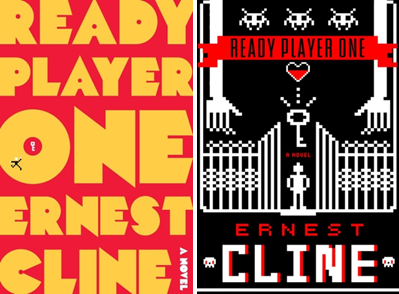
Ready Player One Review

 by DigitaLoz


In his debut novel, Ernest Cline does not simply present a fun novel but a love letter toward geekdom. Cline, as screenwriter at its best, is known for films of the geeky variations like Fanboys. Ready Player One tells the story of a dystopian future in which oil is increasingly hard to come by, the gap between the social classes has been driven to a breaking point, and the only thing keeping people at ease is the Oasis. The Oasis is a blend between an mmorpg and a virtual reality; in some places it’s gone to fat as to replace the educational system. James Halliday, a genius game developer, is the mastermind behind Oasis. Upon his death, James leaves his multibillion dollar legacy to whomever finds an Easter egg inside Oasis; five years have passed and nobody has come close. Grunters, egg hunters, are born from this dystopian future, forever searching for Easter eggs and clues.


Apart from having a lot of fun reading Ready Player One, half the time I was scavenging through references of Joust (a decade old video game), Rush, and Earthbound; obscure allusions of Will Wheaton, Ultraman and Supaidaman were also worth googling. While the story is not too complex and there are no real surprises, it manages to get the reader rooting for these characters as they battle the big corporation and be the first to find the Easter egg. It is the classic battle between man and corporations. Ready Player One is an 80’s geek fest of epic proportions.

My only gripe with the book is that it is categorized as a YA novel, and I understand that it reads like one, yet it references are so obscure I doubt a sixteen year old might get them—supaidaman, Mechagodzilla, and Joust being the least common among casual gamers. I could not help but reminisce on playing Joust back in fourth or fifth grade in the old Macs in my school. I can only hope that those whom read this book and do not know about these mentions will go and find out for themselves.

Beyond the incredible technology driven setting, Ready Player One tugs at the hardcore gamers’ nostalgia. It is about looking back at all the things we loved when we were kids and remembering them like it is the first time. Whether one enjoyed Star Wars or Super Mario Bros., Ready Player One connects with geeks; in doing that, Ready player One immensely succeeds.